

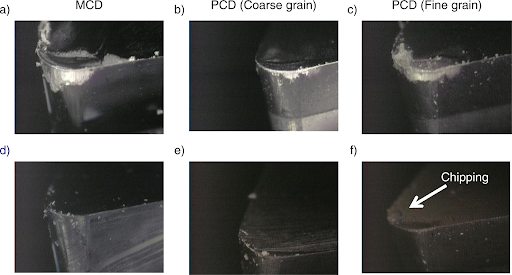
1.The cutting tools grades and specifications are improperly selected, such as the thickness of the blade is too thin or the grades that are too hard and brittle are selected for rough machining.
Countermeasures: Increase the thickness of the blade or install the blade in a vertical position, and choose a grade with higher bending strength and toughness.
2. Improper selection of tool geometry parameters (such as excessive front and rear angles, etc.).
Countermeasures: The tool can be redesigned from the following aspects.
(1) Reduce the front and rear angles appropriately.
(2) Use a larger negative blade inclination angle.
(3) Reduce the entering angle.
(4) Use larger negative chamfering or cutting edge arc.
(5) Sharpen the transition cutting edge to enhance the tool tip.
3. The welding process of the blade is incorrect, causing excessive welding stress or welding cracks.
Countermeasures:
(1) Avoid using a blade slot structure with three sides closed.
(2) Correctly select solder.
(3) Avoid using oxyacetylene flame to heat welding, and keep heat after welding to eliminate internal stress.
(4) Use mechanical clamping structure as much as possible
4. Improper sharpening methods can cause grinding stress and grinding cracks; excessive vibration of the teeth after sharpening PCBN milling cutters will cause excessive load on individual teeth, which will also cause tool hitting.
Countermeasures:
(1) Use intermittent grinding or diamond wheel grinding.
(2) Choose a softer grinding wheel and dress it frequently to keep the grinding wheel sharp. ③Pay attention to the quality of sharpening and strictly control the vibration of the cutter teeth.
5. The selection of cutting amount is unreasonable. If the amount is too large, the machine will become stuffy; when intermittent cutting, the cutting speed is too high, the feed rate is too large, and the blank margin is uneven, the cutting depth is too small; cutting high manganese For materials with high work hardening tendency such as steel, the feed rate is too small.
Countermeasure: Reselect the cutting amount.
6. Structural reasons such as the uneven bottom surface of the slot of the mechanical clamping tool or the excessively extended blade.
Countermeasures:
(1) Trim the bottom surface of the knife groove.
(2) Reasonably arrange the position of the cutting fluid nozzle.
(3)The hardened shank adds a hard alloy gasket under the blade.
7. Excessive tool wear.
Countermeasures: Change the tool or the cutting edge in time.
8. The cutting fluid flow is insufficient or the filling method is incorrect, causing the blade to heat up and cracking.
Countermeasures:
(1) Increase the flow of cutting fluid.
(2) Arrange the position of the cutting fluid nozzle reasonably.
(3) Use effective cooling methods such as spray cooling to improve the cooling effect.
(4) Use * cutting to reduce the impact on the blade.
9. The tool is not installed correctly, such as: the cutting tool is installed too high or too low; the face milling cutter uses asymmetric down milling, etc.
Countermeasure: Reinstall the tool.
10.The rigidity of the process system is too poor, causing excessive cutting vibration.
Countermeasures:
(1) Increase the auxiliary support of the workpiece to improve the rigidity of the workpiece clamping.
(2) Reduce the overhang length of the tool.
(3) Properly reduce the clearance angle of the tool.
(4) Use other anti-vibration measures.
11. Inadvertent operation, such as: when the tool cuts in from the middle of the workpiece, the action is too violent; the tool has not been retracted, and it stops immediately.
Countermeasure: Pay attention to the operation method.
<< :PCD cutting tools for Aluminum Alloy
<< :Research on Cutting Performance of PCD Tool Turning Super-hard Aluminum Alloy(Part 2)

Custom electroplated, sintered & CVD‑enhanced diamond rotary dressers for aerospace, semiconductor, new‑energy vehicle, robotics. High profile accuracy & long service life.

What Can a CVD Diamond Do? Complete industrial chain from CVD diamond plate, precision grinding to CVD / PCD cutting tool manufacturing, Moresuperhard one‑stop superhard processing solution.
Add: Zhongyuan Rd, Zhongyuan District, Zhengzhou, 450001, Henan, China
Tel: +86 17700605088



